How we maintained 90% occupancy during the Iran crisis
The exodus did not arrive as a trend line. It arrived as a series of empty apartments.
Over a short window, more than sixteen tenants left. Not at the end of their terms, not with the notice their contracts required. Some sent a message after the fact. Several simply went, and we found out when a neighbour mentioned it, or when a technician attended for a routine job and the unit was bare. Not one of them honoured the remaining cheques. Every post-dated cheque we held against those tenancies was worthless the moment the tenant was in another country.
That is the part owners rarely say out loud. The cheque is not security. It is a convenience that works beautifully right up until the moment you actually need it, and then it is a piece of paper and a legal process against someone who has left the jurisdiction. When people are frightened, the contract does not hold them. Nothing holds them.
So we had a sudden block of vacant units, no recoverable income from the tenancies that created them, and a market where every landlord in the same buildings was discovering the same thing on the same weekend.
The real problem was not vacancy, it was simultaneity
A vacancy in a normal month is an administrative task. You re-let it. The unit sits empty for two or three weeks, you take the hit, life continues.
A crisis vacancy is different, because everybody has one. Walk into any of the towers we operate in during that period and you would find multiple units available in the same building, often on the same floor, all of them chasing a tenant pool that had just shrunk. And because everyone was frightened, everyone did the obvious thing: they cut the rent.
That is the trap. When the entire building drops price at once, price stops being a differentiator. You cut to match the unit below you, they cut to match you, and within a fortnight the whole stack has repriced downward and nobody has let anything. You have given away yield and gained nothing, because the tenant looking at four apartments in one building is no longer choosing on price. All four are cheap now. They are choosing on something else.
Understanding that early is most of the answer. We never dropped below 90 percent occupancy for more than fourteen consecutive days, and we are at 100 percent now. Here is what actually did it.
We went directly to the five largest brokerages
Not a listing. A relationship, with named people.
In a normal market you can be passive about agents. You put stock on the portals and wait. In a contracting market the portal is a queue, and your unit is one of forty in the same search result. The unit that lets is the one an agent personally walks a client to, because an agent with three viewings booked decides which order to show them in, and that order is not random. It is based on who they know, who pays promptly, and whose apartment will not embarrass them in front of a client.
So we established direct lines into the five largest brokerages operating in our areas. Real contact with real leasing heads. They knew exactly what we had, what condition it was in, and that if they brought a tenant the paperwork would be clean and the commission would be paid without a chase. That last point is worth more than landlords think. Agents talk to each other about who pays.
We automated availability to every RERA-registered listing agent, weekly
The five brokerages gave us depth. This gave us reach.
Every Monday morning, an automated schedule of our available units went out to every RERA-registered listing agent we could reach: unit, building, area, rent, availability date, condition. No chasing, no manual mail merge, no forgetting. It simply arrived, every week, in the inbox of every agent working the areas we operate in, at the start of the week when they are planning who to show what.
The mechanism matters less than the consistency. An agent who receives your availability every Monday for a month starts to treat you as a source of stock rather than a one-off enquiry. When a client calls them with a requirement, you are already in their head. In a crisis, being the landlord an agent thinks of first is worth more than any discount you could offer.
It also solved a problem that quietly costs owners a lot of money: stale listings. Agents were never working from a three-week-old picture of what we had. If a unit let on Wednesday, it was off the Monday list. If one became available on Thursday, it was on it. Accurate stock information, delivered relentlessly, to everyone who could move it.
We paid brokers an extra 5 percent on top of the tenant's commission
The standard arrangement has the agent paid by the tenant. We added 5 percent from our side, paid by us, on top.
This is where owners get squeamish, and it is the wrong instinct. Consider what you are actually comparing. An empty unit at 100,000 dirhams a year costs you roughly 274 dirhams for every day it stays empty. Two months of vacancy is over 16,000 dirhams, gone permanently, never recovered. Against that, a few thousand dirhams to make your apartment the one an agent pushes first is not a cost. It is the cheapest week of rent you will ever buy back.
And it changes agent behaviour immediately. An agent holding a client with a three-apartment shortlist, where one of those apartments pays them meaningfully more, is a human being with a mortgage. They will not lie to their client. But they will show yours first, they will show it with enthusiasm, and enthusiasm at a viewing is worth a great deal.
We worked with area specialists rather than generalists
An agent who works one tower knows which apartments have the noise from the road, which line has the better light, which floors have had the water issues. They are not selling an address, they are selling a specific apartment to someone whose requirements they understand.
Those are the agents who let units in a bad market. We concentrated on them rather than spreading thin across everyone with a licence.
The thing that actually decided it: every unit was renovated
Everything above is mechanism. This is the reason it worked.
When we acquire a unit, we renovate it before it is ever let. New kitchen, new bathrooms, new flooring. Not a refresh, not a cosmetic tidy. Replaced.
This is genuinely painful at acquisition. It adds a month, sometimes two, before the unit produces a single dirham of income, and during that period you are carrying the cost of an asset doing nothing. I have felt that impatience every single time. Every instinct says to let it as-is, take the rent, improve it later.
And at every check-out, the unit is put back properly. Repainted. Silicone redone throughout. Deep cleaned. The apartment the next tenant views is not the apartment the last tenant lived in; it is the apartment as it was the day it was first finished.
Now put that in a crisis.
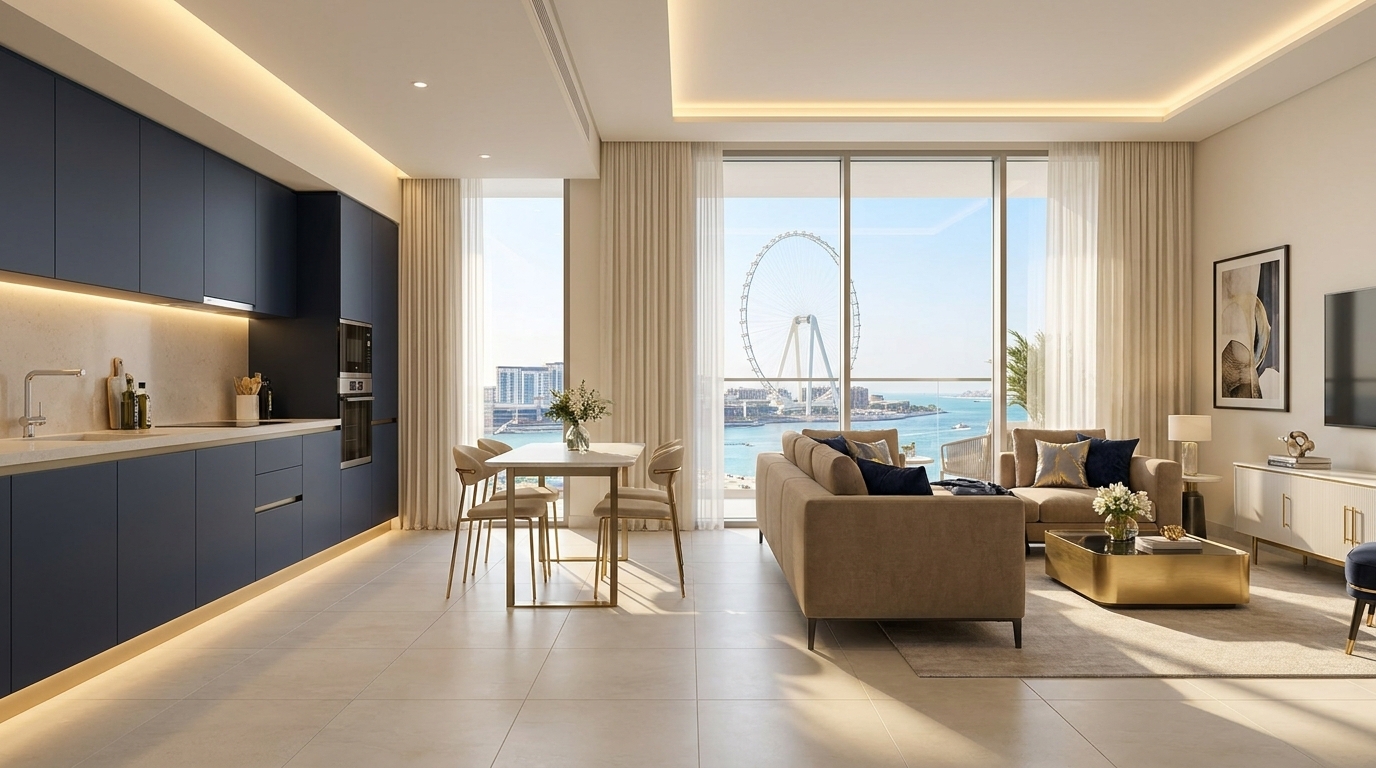
A tenant is viewing four apartments in one building on a single afternoon. All four have dropped their rent. Three of them have the original developer kitchen, a bathroom with tired grout and yellowing silicone, scuffed paint and whatever flooring was installed when the tower handed over. One has a new kitchen, a modern bathroom, fresh flooring, clean silicone, indirect lighting, and paint that was applied for this tenant rather than the last one.
That tenant is anxious. They are making a decision in an uncertain moment, and they are about to commit a year of rent to it. The renovated apartment does not just look better. It feels safer. It signals a landlord who maintains things, which means a landlord who will answer the phone when the air conditioning fails in August.
They take the renovated unit. Consistently. Even at a similar price to the others, often even at a small premium, and certainly if you let it go at a modest discount, because now they feel they have found something.
That is the whole thing, really. In a normal market renovation is a yield improvement, a few percent on the rent, a slightly better class of tenant. In a crisis it is the difference between letting and not letting. When price stops differentiating, condition is all that is left, and condition cannot be conjured in a week. It has to already be there when the market turns.
What I would tell another owner
Do not cut price first. It is the fastest lever and the least effective one, and in a building where everyone is cutting, it achieves nothing except a permanently lower rent roll.
Instead: be the unit agents want to show, make it worth their while to show it, make sure every agent in the area knows on Monday morning exactly what you have, and above all make sure that when the viewing happens, yours is visibly the best apartment in the building.
The renovation decision that costs you two months of income at acquisition is the same decision that keeps you at 90 percent occupancy when a regional crisis empties your building. You do not get to make it after the crisis starts. You make it years earlier, and then one difficult month you discover that you have already done the hard part.
Sixteen tenants left without notice and not one cheque cleared. We were still above 90 percent within two weeks, and we are full today. Not because we were clever during the crisis, but because of what had already been built into the apartments long before it.